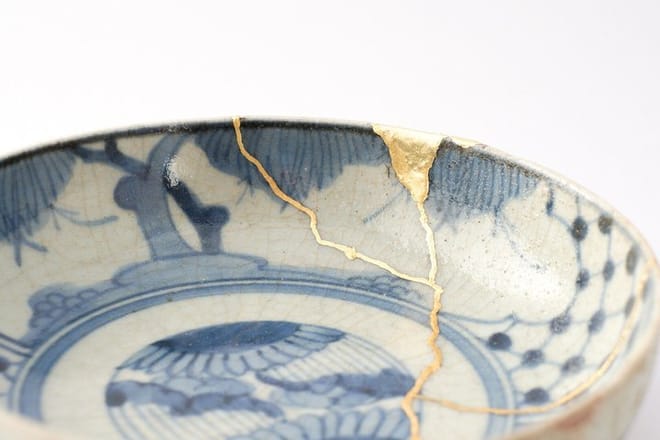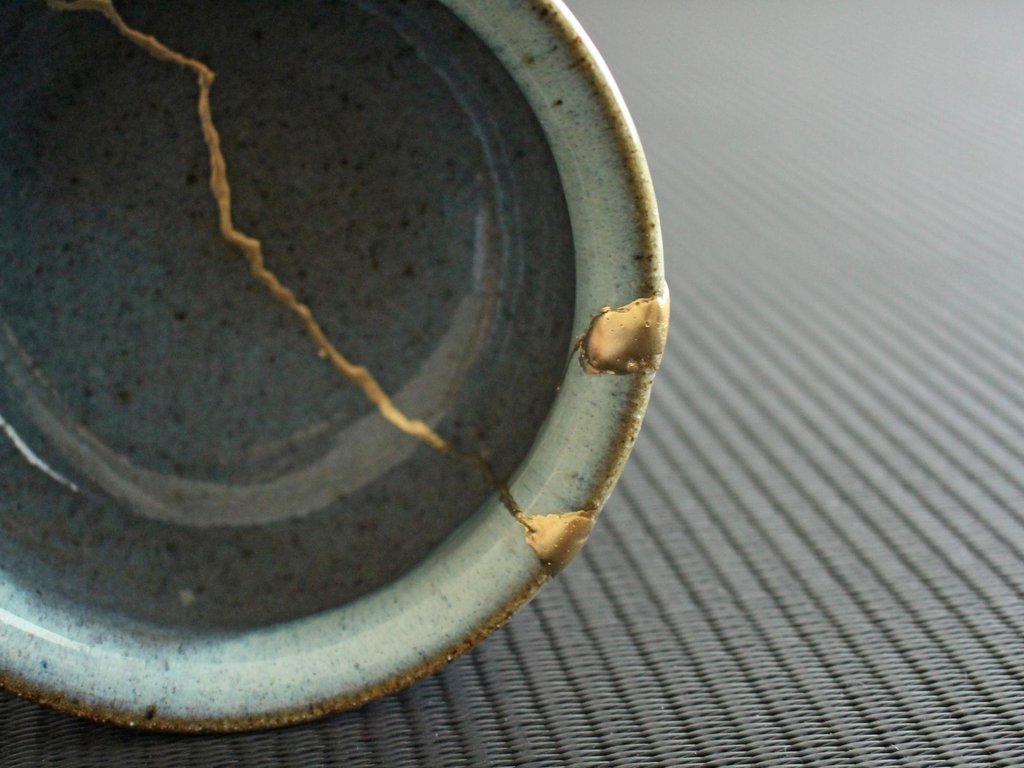
Whether a bowl repaired with kintsugi (the Japanese technique of mending broken or chipped vessels with lacquer and gold powder) is safe to eat from depends on the specific materials used, so the answer is not the same for every piece. Safety depends on the substances used in the repair and on whether they have fully cured.
Natural urushi lacquer (sap tapped from the lacquer tree), epoxy resin, synthetic lacquer, and metal powders each require different checks. Below are the ingredients to confirm before you buy a food-safe kintsugi kit, along with the care routine that keeps a repaired piece in service.
4 Points That Determine Whether Kintsugi Is Food Safe
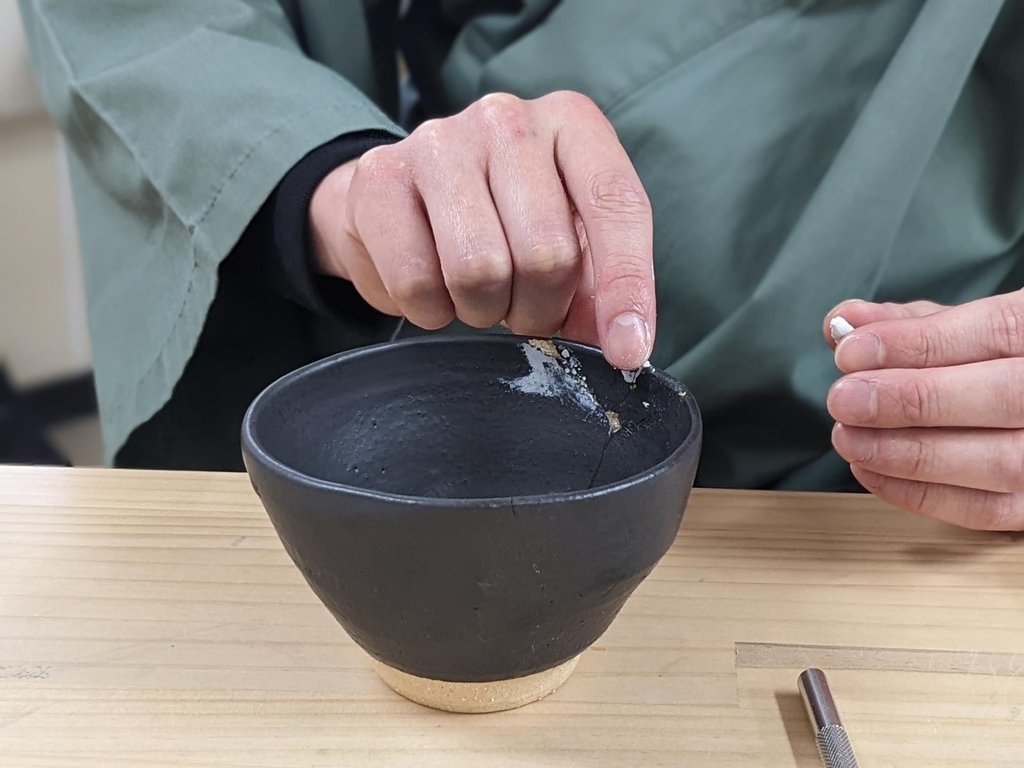
Whether a mended piece belongs on the table comes down to the materials used and how fully the lacquer has cured. The parts that touch food or your lips deserve particular attention, and pieces found unsuitable for food contact still have practical uses.
1. Safety Depends on the Materials Used, Not the Name of the Technique
A repair labeled “kintsugi” is not automatically safe. The same name covers completely different materials depending on the kit or the workshop.
- Traditional kintsugi: natural urushi and other natural materials, combined with pure gold or pure silver powder
- Modern DIY kits: synthetic materials such as epoxy resin, combined with brass powder or glitter
No unified third-party certification backs the words “food safe” on a product page, and in many cases the claim comes from the seller alone. Check which test standard or legal compliance supports it.
2. Natural Urushi Cannot Touch Food Until It Has Fully Cured
Natural urushi does not harden by evaporation like ordinary paint. Enzymes in the sap drive an oxidative polymerization reaction, which requires a temperature of 20–25°C (68–77°F) and humidity of 70–80%.
Allow at least two months for every stage of the work to cure completely. Even when the surface feels dry, the reaction may still be running underneath, and uncured lacquer components can migrate into food.
Signs that curing has finished:
- At least two months have passed since the final coat
- The distinctive smell of lacquer has almost disappeared
- The surface has no tackiness or stickiness at all
Confirm that all three apply.
3. Only the Areas That Touch Your Mouth or Food Matter
Rather than judging the whole vessel at once, check only the areas that food and lips actually touch.
The main food-contact areas are:
- The rim and the interior surface, where food or lips make direct contact
- The inner base and sides, where chopsticks and spoons repeatedly strike
The outside of a vessel and the kodai (the footed base underneath) never touch food, so a synthetic-resin repair there carries less risk. Bowls that hold boiling liquid, such as those used for miso soup, are a special case: repair material on the outside can soften at high temperatures, so consider how and at what temperature you will use the piece.
4. Pieces Unfit for Dining Still Work as Vases and Display Objects
A vessel repaired with epoxy or synthetic lacquer does not necessarily need to be thrown away. If you no longer use it for food, the material’s food-contact suitability is no longer the main concern.
- Display seasonal flowers in it as a bud vase or flower vessel
- Use it as a catch-all or accessory tray by the entryway
- Enjoy it as a decorative plate on a shelf
- Turn it into a candle holder as part of your interior
Decide before the repair whether the piece is intended for the table or for display. That choice helps narrow down which materials and kits are worth considering. Genuine urushi with pure gold powder suits tableware, while a DIY synthetic-resin kit can be a practical option for decorative pieces.
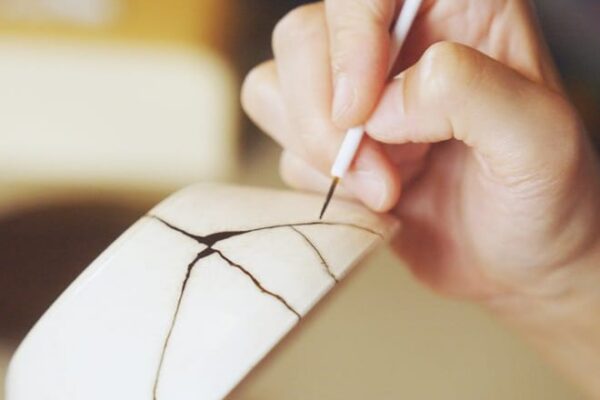
Tokyo: Japanese Gold Repair Kintsugi Workshop in Shinjuku
Kintsugi Materials and Their Food-Safety Verdicts
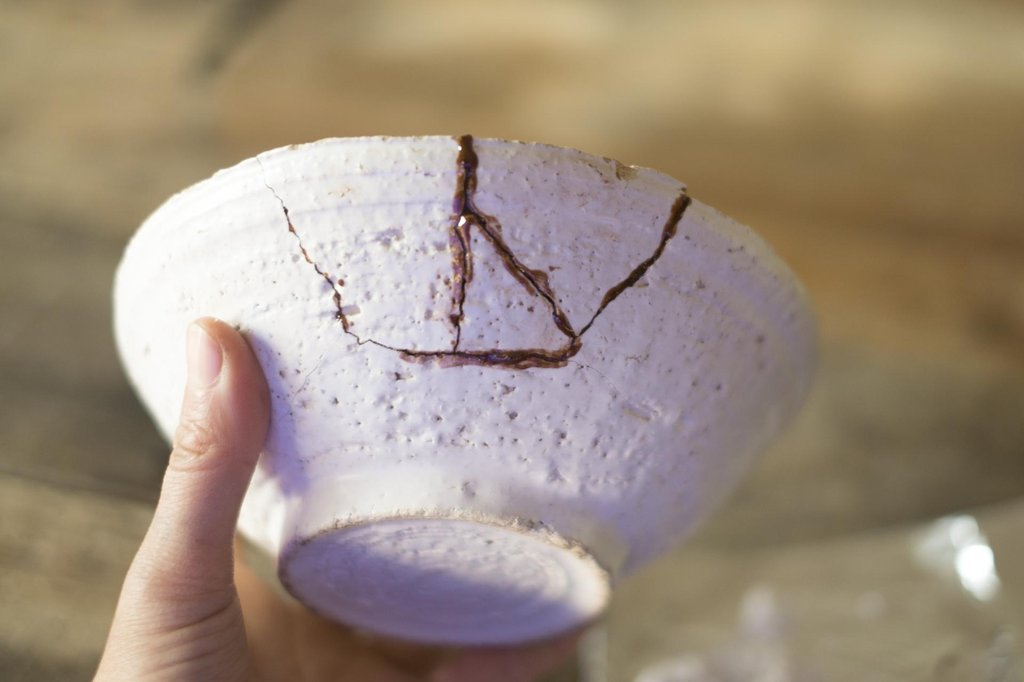
The materials used in kintsugi vary widely in how safely they can be used with food. Five of the most common are traditional natural urushi and pure gold powder, along with three common substitutes: epoxy resin, cashew lacquer, and brass powder.
Compare them against what is in your own piece or kit to judge whether it can serve as tableware.
Natural Urushi: Safe for Tableware Once Cured
Natural urushi is safe in contact with food once it has cured completely. In Japan it has coated bowls and chopsticks for centuries.
Moisture in the air and enzyme activity trigger a polymerization reaction that turns the lacquer into a hard film resistant to boiling water and weak acids. That curing normally takes two to three weeks, and longer in some environments, so a freshly coated piece should not go straight to the table.
- Mugi-urushi (lacquer kneaded with wheat flour), used as an adhesive
- Sabi-urushi (lacquer mixed with polishing powder), used for filling and undercoating
- Bengara-urushi (lacquer mixed with bengara, an iron oxide pigment), used for the middle coat
All three are based on natural urushi, and their safety after curing is the same.
Pure Gold, Silver, and Platinum Powder: Safe in Contact With Food
24K gold powder, pure silver powder, and platinum powder are all chemically stable metals that do not dissolve on contact with food or saliva. Because the body does not absorb them, they are considered safe for food-contact use.
Purity has a dramatic effect on both safety and price, so keep these differences in mind when choosing a kit.
| Type of Powder | Food Contact | Price Range per Gram |
|---|---|---|
| 24K pure gold powder | Safe | Several thousand yen to around ¥10,000 |
| Pure silver powder | Safe | Several hundred to around ¥1,000 |
| Brass powder (gold-colored substitute) | Not confirmed | Around a few dozen yen |
The “gold powder” in an extremely cheap kit may be brass (an alloy of copper and zinc), so always check that the product description states “24K” or “pure gold.” Pure silver powder deepens in color as it reacts with sulfur in the air, but that does not affect its safety.
Epoxy Resin: Not Permitted for Tableware Under Japanese Law
Japan operates a positive list system for synthetic resins used in utensils, containers, and packaging for food, and the system has been in full force since the transitional period ended on June 1, 2025. Rather than concluding on your own that a resin is “safe once fully cured,” confirm that the manufacturer permits use on tableware or provides compliance information for food-contact applications.
When choosing an off-the-shelf simplified kintsugi kit, check the following.
- Whether it states “suitable for tableware” or “for food-contact use,” and presents compliance information for tableware use, such as under the Food Sanitation Act
- Whether the required curing time and conditions after use are clearly stated
If the labeling alone does not settle the question, ask the manufacturer whether you may use the product on food-contact surfaces before you start.
Cashew Lacquer and Synthetic Lacquer: Synthetic Resins, Not for Tableware
Cashew lacquer is a synthetic resin coating made by chemically processing the shell liquid of cashew nuts. Its manufacturers do not recommend it for tableware.
Products sold as shin-urushi or kogei-urushi (Japanese labels for lacquer-look coatings) also consist of synthetic resin and organic solvents, so they are not genuine natural urushi despite the name. Some kintsugi kits include products of this kind, so judge by the ingredient list rather than the product name.
- Ingredients listed as “synthetic resin” or “organic solvent” are unsuitable for tableware
- In English labeling, “natural lacquer” or “urushi” signals genuine natural lacquer
- When in doubt, check the manufacturer’s official site for its position on food contact
Japanese law no longer permits the use of a synthetic resin that is off the list for tableware, so read the ingredient labeling closely.
Brass and Mica Powder: Safety Not Confirmed
The gold-colored powder in a kintsugi kit costing a few thousand yen may be brass powder or mica powder (a pearlescent pigment) rather than real gold.
Neither material should be assumed to be suitable for food contact unless the manufacturer specifically confirms its safety for that use. They produce these materials for craft and coating work, so tableware that touches the mouth falls outside their intended use.
Japan’s Food Sanitation Act prohibits metals with a lead content above 0.1% on food-contact surfaces. When a seller does not disclose an inexpensive powder’s composition, you have no way to confirm that it meets the standard.
Keep powders of unconfirmed safety away from anything that touches the mouth. When buying a kintsugi kit intended for tableware, check the product information for the exact powder material, purity, and food-contact safety claims.
How to Choose a Food-Safe Kintsugi Kit
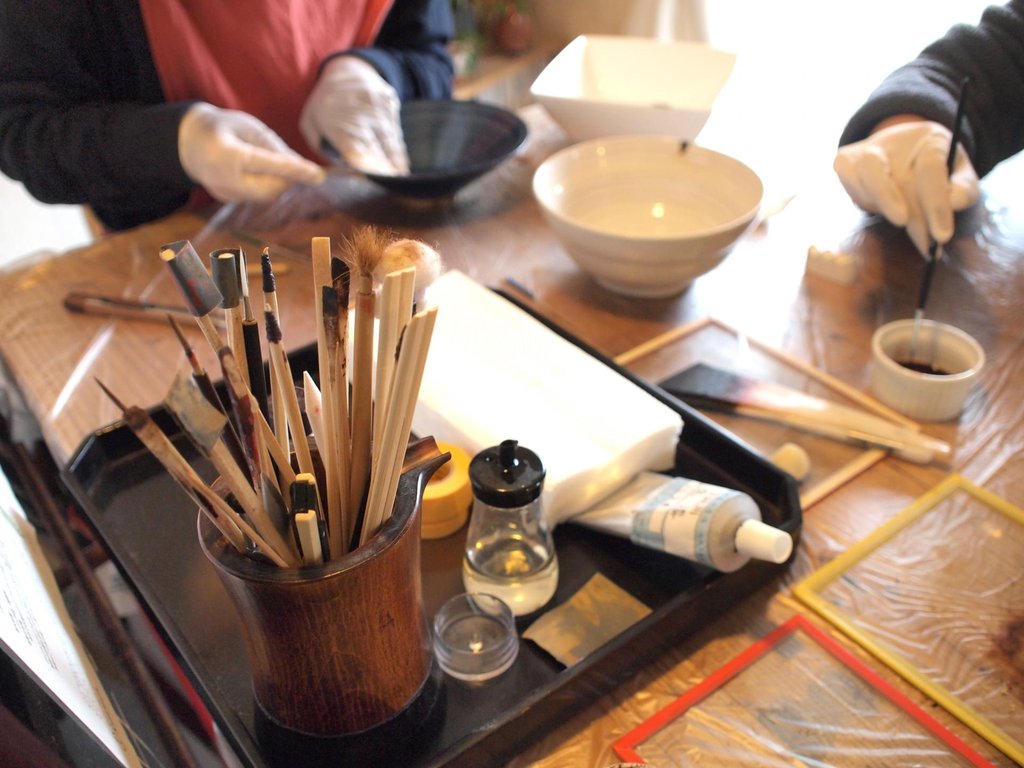
Choosing a kintsugi kit for tableware means looking beyond the packaging to the materials inside and the evidence supporting their safety.
Before buying, check how to read the ingredient list, how much weight to give a “food safe” claim, the curing period required for natural urushi kits, and the typical price range.
Check the Ingredient List for Natural Urushi and Pure Metal Powder
Sellers market kits made with epoxy resin and brass powder under the same “kintsugi” name, so the name alone says nothing about food safety. Read the ingredient list on the packaging or product page before buying.
- The adhesive and coating material should be natural urushi (natural lacquer). Wording such as “synthetic resin” indicates a different material and should not be treated as equivalent to traditional urushi.
- The metal powder should be pure gold, pure silver, or platinum, since “brass” and “mica” are not intended for food contact
Treat a kit that discloses no ingredients with caution. If the seller cannot provide clear information about the materials and their intended food-contact use, it is safer to reserve the kit for decorative repairs rather than tableware.
Verify the Basis Behind “Food Sanitation Act Compliant” and “Food Safe” Claims
A label reading “food safe” or “compliant with the Food Sanitation Act” proves little unless it names the standard and the testing body behind it. An overseas “food safe” claim may rest on standards such as those of the US FDA, which do not guarantee safety for use as tableware in Japan.
Confirm these three points before buying:
- Which country’s standard or law the product complies with (Japan’s Food Sanitation Act, the FDA, and so on)
- Whether the name of the third-party laboratory that ran the testing appears
- Whether the test covered the finished product or only part of the raw materials
If this information is not available, contact the seller directly. If the seller cannot provide a clear answer, it is safer to use the product only for decorative pieces or flower vessels rather than food-contact tableware.
Expect Natural Urushi Kits to Take Months to Cure
Natural urushi hardens through humidity in the air and enzyme activity, and full curing takes roughly three to six months.
Contact with food before curing finishes leaves a risk that lacquer components can leach out, so prepare a suitably humid environment and let the process run its course.
- Line the bottom of a sealable plastic container with a cloth or towel dampened with water
- Raise the repaired piece on a rack or disposable chopsticks so it never touches the water directly
- Hold the container at around 20–25°C (68–77°F) and 70–80% humidity, re-dampening the cloth every one to two days
If you want a finished piece within a few weeks, treat the project as decorative instead — that is the more realistic route.
Natural Urushi and Pure Metal Kits Run ¥8,000–¥20,000
A full kintsugi kit using natural urushi and pure gold powder typically costs around ¥8,000–¥20,000 (about 135 USD). Natural urushi is available only in limited quantities, while pure gold powder is expensive, which puts these kits well above simplified alternatives.
Kits in the ¥2,000–¥3,000 range are generally simplified products using epoxy resin and brass powder. Price alone does not reveal the materials, so check the following before buying:
- Whether the adhesive and coating material is described as “natural urushi” or “raw urushi”
- Whether the metal powder states its material and purity, such as “pure gold” or “pure silver”
Genuine kits can sometimes appear at lower prices during sales, so a cheap price does not automatically mean a kit is unsuitable. Check whether the product still clearly discloses its materials and purity, and choose based on the ingredient information rather than the price tag alone.
Tokyo: Japanese Gold Repair Kintsugi Workshop in Shinjuku
Caring for a Kintsugi-Repaired Piece So It Lasts
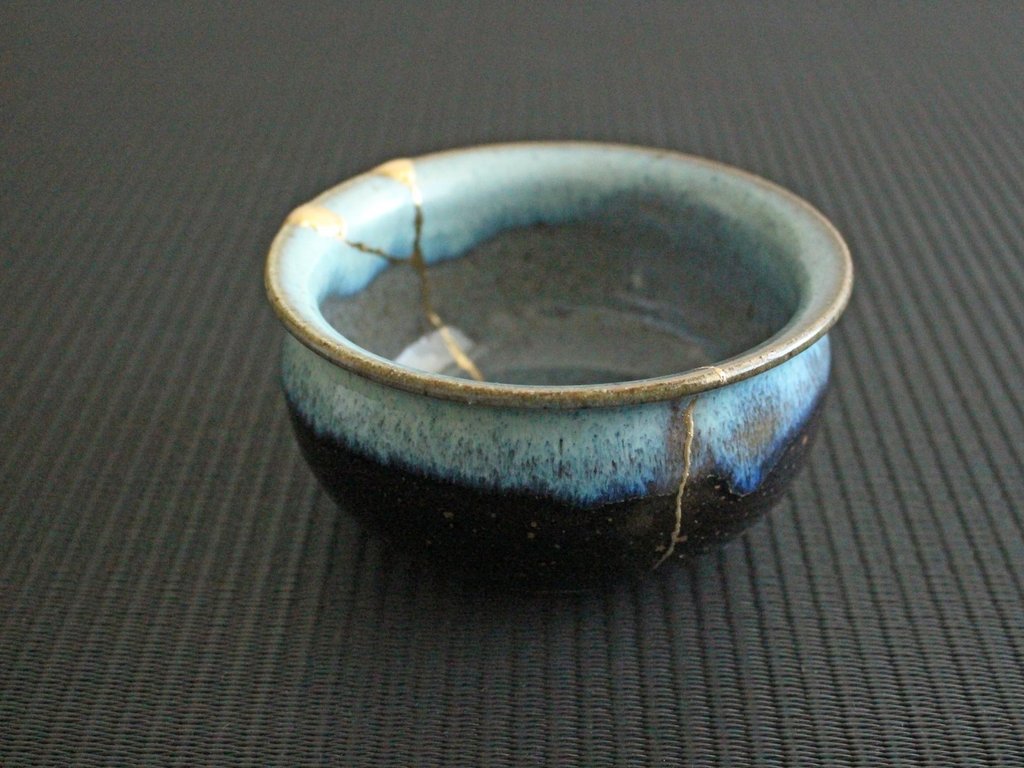
Even a carefully repaired piece can shed its mended seam or discolor if handled carelessly day to day. The points to watch are heating appliances and dishwashers, hand-washing technique, chemical damage, and storage.
Keep It Out of Heating Appliances and the Dishwasher
Even a piece finished with natural urushi should not be used in a microwave, dishwasher, or oven. These appliances can damage the lacquer film or the metal-powder finish.
- Microwave: metal powder can react to microwaves and cause sparking, while temperature changes can make the lacquer film more prone to cracking
- Dishwasher: high temperatures and strong water jets can wear away the lacquer film and loosen the gold powder
- Oven: intense heat can scorch the lacquer film and turn the repaired area black
When reheating soup or a simmered dish, warm it in a separate heatproof container and transfer it to the kintsugi piece afterward.
Hand-Wash With a Soft Sponge and Neutral Detergent
Scrubbing with your everyday sponge or leaving the piece to soak damages the golden seam.
Never use an abrasive sponge or a scouring pad. Every pass of a stiff surface shaves away a little gold powder, so choose a fine, soft sponge of the type sold for delicate dishware.
- Detergent: apply a small amount of neutral dish detergent and wash gently with lukewarm water, using a stroking motion
- The seam: over the golden lines, let the sponge glide rather than press
- No soaking: water works its way in and causes peeling and swelling
- Washing time: finish within one to two minutes
Air drying tends to leave water spots, so dry the piece by hand the moment you finish washing.
Avoid Prolonged Exposure to Bleach and Highly Acidic Foods
Chlorine bleach and strongly acidic foods both damage the lacquer film of a kintsugi repair.
Never use chlorine bleach. Its powerful oxidizing action breaks down the resin structure of the lacquer, so when a stain bothers you, soak the piece briefly in lukewarm water with diluted neutral detergent instead.
Acidic foods also call for some care. They are generally fine for the length of a meal, but washing the piece soon afterward helps minimize prolonged exposure.
- Chlorine bleach: never use it; substitute lukewarm water and a diluted neutral detergent
- Serving acidic foods: fine for the duration of a meal, but wash the piece soon afterward
- Soaking: avoid prolonged soaking, whether the liquid is acidic or alkaline
Extended contact with acidic substances can cloud or damage the lacquer surface, so prompt washing is a good habit for preserving a kintsugi repair.
Wipe It Dry and Store It Somewhere Well Ventilated
Water droplets left on the lacquer film for long periods can cause a white haze. Dry the piece by hand as soon as you take it out of the water. Use a cotton towel or kitchen paper and wipe gently in one direction, following the golden seam.
Three factors matter when choosing a storage spot:
- Ventilation: a cabinet whose door can remain slightly open is better than the back of a shelf where air stagnates
- Direct sunlight: ultraviolet light degrades the resin in the lacquer, causing discoloration and cracking
- Excessive dryness: a spot in the direct path of an air conditioner draws moisture out of the lacquer film
When stacking pieces, place a sheet of thin cotton cloth or washi (traditional Japanese paper) between them to reduce friction against the gold-powder finish.
Common Questions About Kintsugi and Food Safety

Six questions about the safety of kintsugi come up again and again. They cover how to identify the materials used in a past repair, and what to do after eating from a piece repaired with a simplified kit.
Can I Find Out Which Materials Were Used to Repair My Piece?
The surest way is to ask the workshop or artisan who carried out the repair. If you used a DIY kit, check the ingredients on the packaging or through the seller.
| Type of Repair | Typical Repair Period |
|---|---|
| Natural urushi only | 3 to 6 months |
| Synthetic resin (epoxy and similar) | 1 to 2 weeks |
It is difficult to tell natural urushi and synthetic resin apart by appearance alone, so if you cannot identify the material, the safer choice is to hold off using the piece for food. Flower vessels and small storage dishes are among the uses that keep food out of contact.
What Should I Do if I Have Already Eaten From a Piece Repaired With a Simplified Kit?
Start by checking the ingredients of the kit you used and whether the manufacturer explicitly approves the finished repair for tableware or food contact. If no such approval or safety information is available, stop using the piece for food.
- Stop using it for food: repurpose the piece as a flower vessel, small storage dish, or another item that does not come into contact with food
- Ask about redoing the repair: consult a workshop or artisan about whether the existing repair can be removed and the piece repaired again using natural urushi
- Keep the product information: save the ingredient list, product name, and any safety documentation for future reference
If you later notice a health change and suspect a connection to the repair materials, consult a medical professional and bring the ingredient list and product information with you.
Can People With Metal Allergies Use Kintsugi-Repaired Pieces?
If you have a metal allergy, check both the metal powder and the base materials used in the repair. Finishes may use alloys such as brass rather than pure gold, and some people can react to particular metals.
The lacquer or synthetic resin underneath the metal powder should also be identified.
- Check the type and purity of the material used for the finish
- Confirm whether the repair uses natural urushi, cashew lacquer, epoxy resin, or another material
- Consider where the kintsugi seam sits and whether it may come into contact with food or the mouth
When the materials are unknown, ask the workshop that carried out the repair or the seller of the kit for specific information. If you have experienced symptoms consistent with a metal allergy or are uncertain about using the piece, bring the available material information to a doctor for advice.
Can an Artisan Repair Any Piece for Use as Tableware?
An artisan cannot restore every piece for safe use with food. Some materials and types of damage make a repair more difficult, so check with the workshop or artisan before commissioning the work.
- Glassware: the nature of the material can make lacquer-based repair challenging
- Unglazed pottery: highly absorbent surfaces may require preparatory treatment, depending on their condition
- Severely damaged pieces: objects broken into many fragments or missing large sections may be difficult to restore with sufficient strength, depending on the extent of the damage
A repair using natural urushi may take several months to complete. When making an inquiry, attach photographs that clearly show the condition of the piece, explain that you intend to use it as tableware, and confirm the materials that will be used and the care required afterward.
What Should I Watch Out for When Using a Natural Urushi Kit?
Keep uncured lacquer off your skin. Urushiol, a component of lacquer, can trigger allergic reactions such as rashes on contact.
While working, keep the following precautions in mind:
- Wear gloves and long sleeves: prevent the lacquer from coming into direct contact with your skin
- Avoid touching your face or eyes: keep your hands away from your face while handling the material
- Follow the product instructions: Read and follow all safety precautions supplied with the kit or other product
If your skin reacts, stop using the product. If symptoms are severe or widespread, seek medical attention from a dermatologist or another medical professional.
Are There Workshops Where I Can Learn Kintsugi Firsthand?
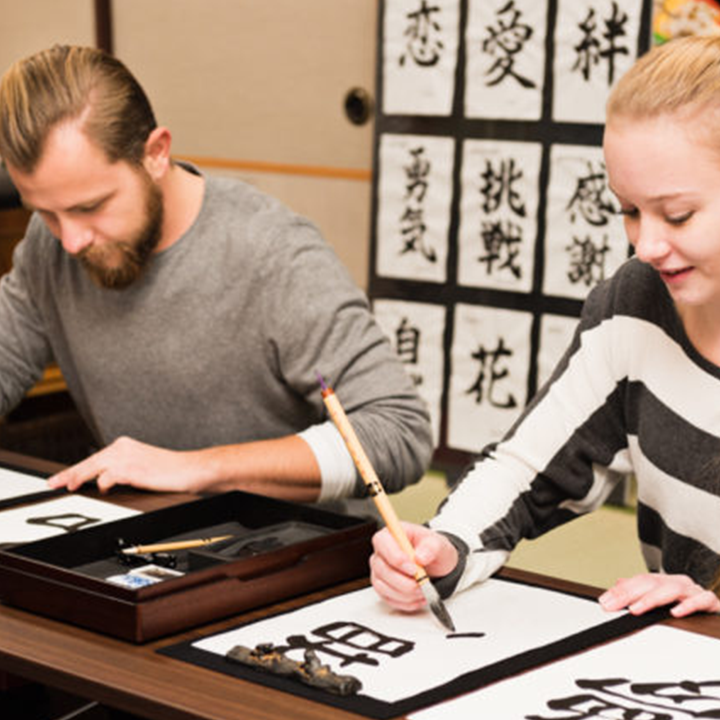
Japan Guide Star runs the Tokyo: Japanese Gold Repair Kintsugi Workshop in Shinjuku, where participants repair a broken ceramic piece using dedicated tools and gold powder, then take the finished work home the same day.
Instructors provide support in English, making the session accessible to visitors who feel uneasy about communicating in Japanese. Alongside the technique itself, the workshop introduces mottainai, the idea of valuing objects and continuing to use them rather than discarding them.
Details
| Meeting point | Chopsticks Studio Shinjuku, 8F Higashi Building, 1-5-4 Kabukicho, Shinjuku-ku, Tokyo |
| Duration | About 1 hour 30 minutes; up to 15 participants |
| Included in the price | Materials, instruction, and taking your finished work home |
| Booking site | https://japanguidestar.com/tour/tokyo-japanese-gold-repair-kintsugi-workshop-in-shinjuku/ |
| Recommended for | Anyone who wants to repair a ceramic piece by hand, and anyone trying kintsugi for the first time |
Because the workshop uses fast-setting materials, participants can take their finished piece home without waiting through the long curing process required for traditional urushi. Those who want to continue practicing kintsugi on their own dishes can later try a full repair using a natural urushi kit or commission a specialist artisan.
Tokyo: Japanese Gold Repair Kintsugi Workshop in Shinjuku
Match the Materials to How You Plan to Use the Piece
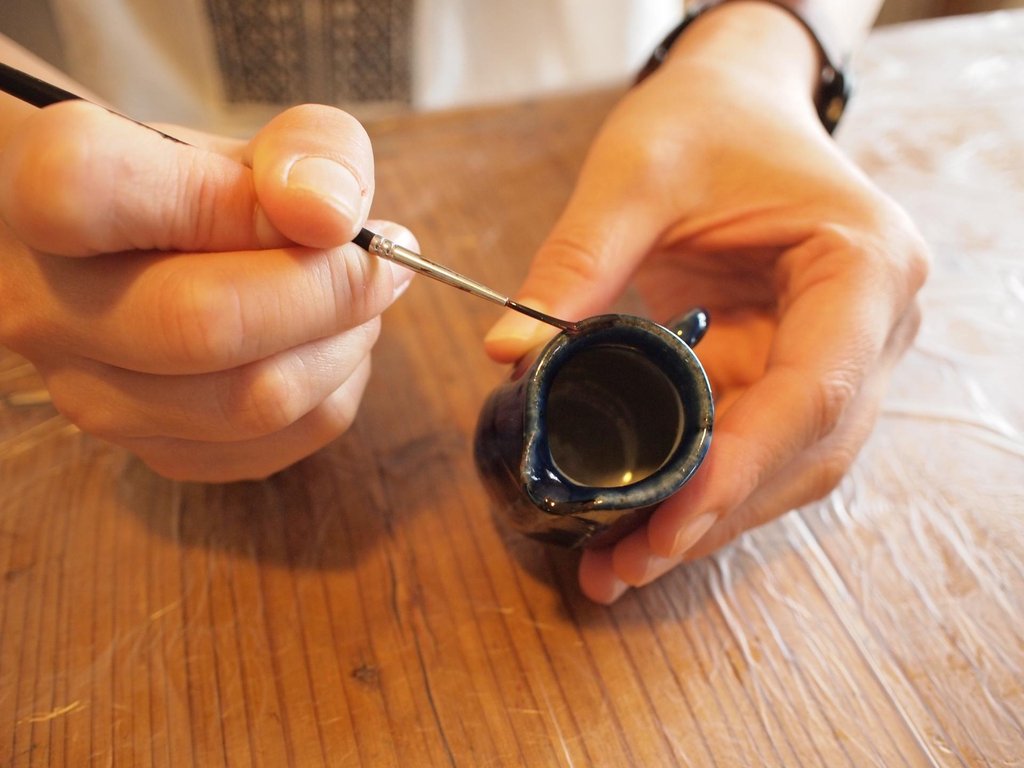
Whether a kintsugi-repaired piece can safely serve as tableware depends on the materials used in the repair and their state of curing, not simply on the name of the technique. Even when natural urushi and pure gold powder are used, confirm that the materials have cured sufficiently and that the finished repair is suitable for food contact.
For a piece repaired with epoxy resin, cashew lacquer, or brass powder, check whether the manufacturer explicitly approves that specific product for food-contact use. When you cannot confirm its safety, keep the piece off the table and enjoy it instead as a flower vessel or decorative interior object.